
Development


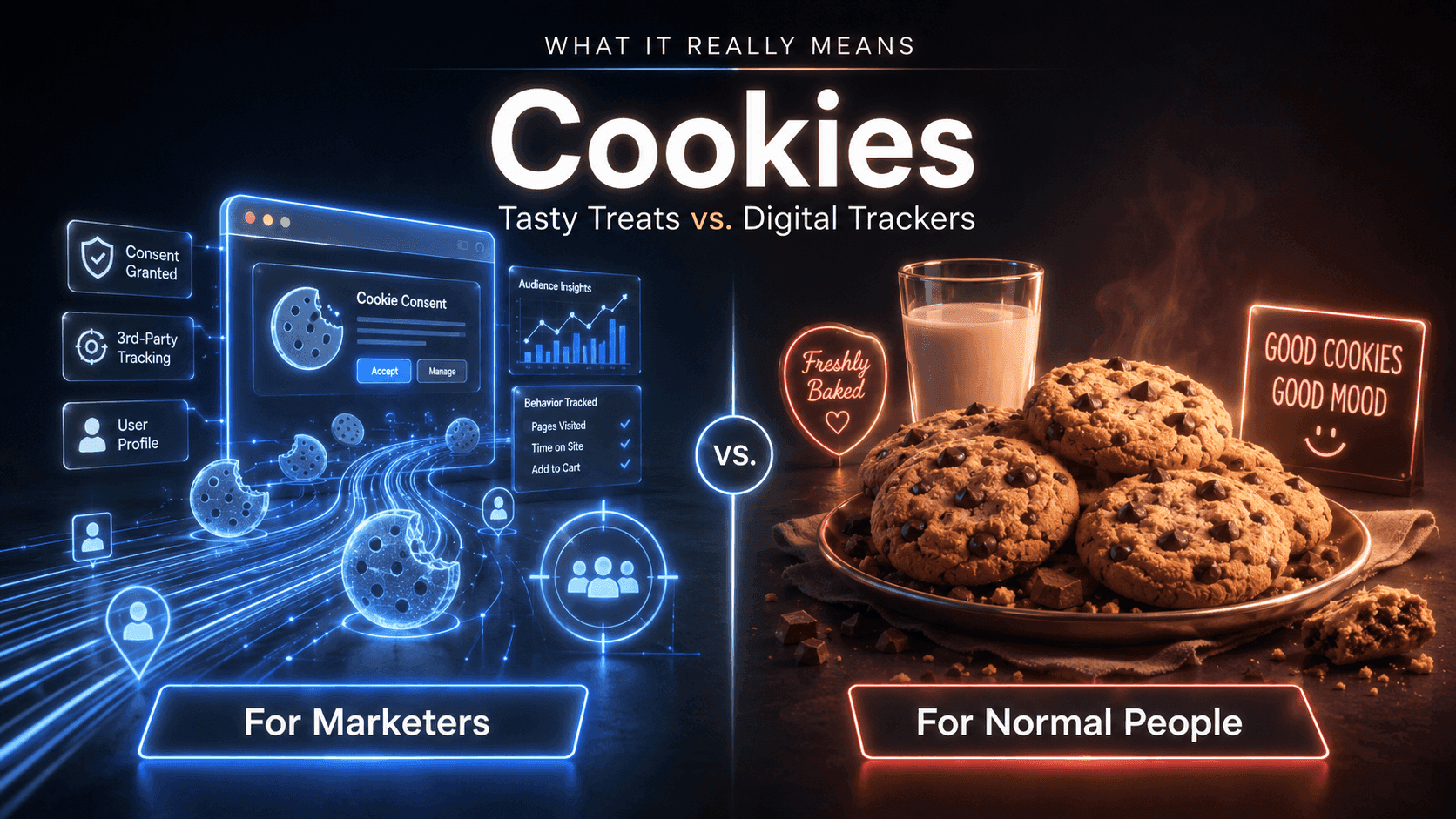
I walked to the kitchen, eyeing the chocolate-chip cookies on the table. To most people, cookies are warm, crumbly treats meant for dunking in coffee. Yet I’ve come to think of cookies as the data shards our ads leave behind; every click, scroll, and purchase becomes a digital crumb. In everyday life, “cookie” means comfort food; in adland, it means consent forms and click-through rates. And that gap in understanding can be hilarious and frustrating.
Once I surprised a colleague with a real chocolate chip cookie and said, “Here’s a cookie!” as if handing him his website analytics report. He grinned, took a bite, and asked if I had sent it through the Privacy Sandbox. That’s when you realize we don’t all speak cookie.
- The People’s Cookie Jar (Consumer Perspective)
Most people just want to enjoy the snack and ignore the fine print. The average web user sees cookie notices as a speed bump to more cat videos or recipes. In fact, surveys show generational divides in cookie tolerance: about 58% of Gen Z often/always hit “Accept” on a banner, versus only 36% of Baby Boomers. In my family, my teenager just shrugs and clicks “OK” (there’s no monster behind it!), while my dad gets suspicious and Googles “Are cookies spying on me?”
Behind the jokes is a real data gap: 50.6% of U.S. consumers admit they accept cookies without really understanding the privacy implications. In other words, half of the population acquiesces to trackers without fully comprehending their implications. And only 17% of people say they always accept third-party cookies, meaning 83% at least sometimes opt out. As one colleague quipped during a consent training, “Umm, I thought a cookie banner was about snacks, not surveillance!”
The upshot: to most folks, “cookie” still means a treat, and the digital meaning is just confusing jargon. They’re not thinking about retargeting algorithms or GDPR fines; they just want to browse without hurdles (and maybe snack uninterrupted). The everyday person’s take: Cookies? Only if they’re sweet and edible.
- The Marketer’s Cookie Jar (Marketing Perspective)
But to us in marketing, cookies are gold, or at least our gold is in them. We use cookies (and related tools) to remember that you liked those running shoes or to prevent showing ads to you again when you just bought them. In agency meetings I often joke, “We’re not sneaky, we’re just data-savvy!” But even I admit it can sound sneaky. In fact, a recent eMarketer report found that only 17% of U.S. consumers always accept cookies. That means the vast majority of browsers (nearly 90% by some estimates) could become “cookieless” soon, as people click “reject” or use blockers.
One recent analysis found that with current opt-in rates, about 87% of US browsers could end up cookieless in the long run. In practice, that means popular browsers (Chrome, Safari, Firefox, and Edge) will mostly be blocking third-party trackers unless the user explicitly opts in. As a marketer, that chart looks like our main tool, “retargeting cookies,” is on its way out of the oven.
We’ve spent years building audiences and lookalikes based on these cookies. Now we have to innovate, not panic. Cookie crumbs still have value: first-party cookies (data from your own website) still remember things like cart contents or login sessions. Contextual cookies (in browsers like Safari/Firefox) do nothing, so we rely more on what the user tells us directly.
In fact, 2024 is shaping up to be what one industry analyst called “the year of All-Party Data”. That means combining first-party data (your own customer lists, email sign-ups, and loyalty information) with cooperative data-sharing partnerships instead of depending only on unknown third parties. Currently, clean rooms and identity graphs are gaining popularity. I've dedicated weeks to strategy sessions with engineers, figuring out how to connect CRM data to ad platforms without compromising privacy.
The Google announcement in mid-2024 felt like a reprieve: Chrome said it would pause removing third-party cookies and instead give users a choice in settings. But marketers shouldn’t get too comfy. Industry commentators noted that the impact of Google's cookie U-turn had "settled" by April 2025. In other words, we got a breather, but the whole landscape has already shifted. Demand-side platforms and publishers are currently experiencing relief, but many of us understand the importance of continuing to adapt.
At my agency, we’ve shifted budgets in subtle ways: less spending on raw cookie-based retargeting, more on building email lists, enhancing in-app tracking, and yes, baking actual cookies for VIP clients with a note: “Just like cookies in your kitchen, we use data to keep you coming back.” (Cheesy, I know, but it sparks a laugh about data habit.)
- Marketers’ Playbook (Structured Insights)
Activate first-party data. Encourage logins, subscriptions, and loyalty programs to gather info legally and kindly. According to a recent industry analysis, marketers are increasingly “activating first-party data, especially through clean rooms” as a main path forward. Think of the situation as using your own cookie jar instead of raiding someone else’s. Use new privacy-friendly tools. Consider exploring Google’s Privacy Sandbox (eventually) or server-to-server APIs such as Meta’s Conversions API. These let you measure campaigns without third-party cookies. For example, Google is rolling out a “consent-based model” where users make one setting for cookies across sites. Embrace that: it’s better to have transparent, consented data than hidden tracking. We employ contextual and creative targeting strategies. If cookies die, we’ll rely more on context. Show ads based on the page content or search terms instead of the person’s history. (Imagine selling gardening tools on a home improvement site by content alone.) Stay agile with creative strategies; the platform may block the cookie, but they can’t block great writing or design. Stay on top of privacy laws. By 2024, 14 U.S. states already had privacy laws in effect, with 40 more bills pending. That means cookies aren’t just a tech issue; they’re legal compliance. Treat privacy as a brand win; talk about how you respect customer data and offer value (coupon for data, transparency badge, etc.). As one Digiday piece noted, brands are shifting from “reactionary” to “offensive,” advocating for privacy while highlighting how properly used data can enhance experience. That’s a narrative any marketer can get behind. In short, mix your data recipes. Don’t rely on one ingredient. Use customer trust as seasoning.
- Myth vs. Fact: Cookies Edition
Myth: “Cookies are just evil little spies; only advertisers use them.” Fact: Cookies serve benign purposes too. First-party cookies remember your login, cart contents, and language choice; without them, shopping online would be as fun as a surprise fruitcake. And in today’s world, only 17% of people always accept third-party cookies, meaning most browsers won’t fire those trackers anyway. In practice, cookies are expected to become the exception rather than the rule, a shift that marketers refer to as a ‘cookieless’ future. So it’s overly simplistic to think “all cookies = evil spy.” Only some cookies (and how you use them) are shady, and users are catching on. Myth: “If cookies go away, we can’t do targeted advertising anymore.” Fact: Marketing will adapt. We’re already shifting to “all-party data” strategies. Blending the data people knowingly give us with privacy-safe solutions. Tools like Google’s Privacy Sandbox (with consent prompts) and Facebook’s Conversions API let us still track outcomes without unauthorized cookies. Even without tech cues, humans love personalization: we’ll use contextual ads, influencer marketing, and good storytelling. We might lose some hand-holding, but we’re gaining better practices. Myth: “Privacy laws will strangle marketing budgets.” Fact: Smart brands turn privacy into a competitive advantage. It’s true that many new privacy rules are being implemented; five states, including Montana and Texas, had laws take effect in 2024, and dozens more are currently being developed, but this only establishes a minimum standard. Marketing that respects consent builds loyalty. I see it as moving from a scorched-earth blitz (spammy banners and pop-ups) to a handshake agreement (“You give me data, I give you value”). As one marketer put it, our industry is trading panic for planning. The brands winning today are those being proactive about privacy; they’re the ones customers will trust tomorrow.
- Conclusion: Cookies Ahead!
The world of cookies (both kinds) is changing faster than a home baker’s oven. As marketers, we need to sprinkle in humor with humility: explain to clients that, yes, their data is safe and the ads are still working, just with new recipes. As consumers, it’s fine to enjoy your oatmeal raisin or chocolate chip in peace; just remember digital cookies need your permission to stick around.
So next time someone offers you a digital cookie, ask yourself: Do I need to read the label, or am I just hungry to move on? We marketers will keep stirring the pot, finding creative, privacy-friendly ways to connect. Because at the end of the day, a good cookie (snack or snippet of data) should leave everyone feeling satisfied, not sick.
What’s your take? How are you rethinking your cookie jar strategy these days? 🍪😊
- Sources Recent industry surveys and reports (2024–2025) highlight that only 17% of U.S. users always accept cookies, with nearly 90% of browsers potentially “cookieless” soon. This scenario has driven the shift to first-party and “all-party” data strategies and a wave of new privacy laws (14 states already enacted, 40 more pending), underscoring the need for marketing that respects consent while still delivering results. These trends form the backdrop of the marketer’s journey from cookie jars of data to privacy-aware tools.
Stay updated on tech trends
Join our mailing list for exclusive insights and practical tech advice delivered to your inbox.
Other Blog Posts














For Businesses
Need expertise on your next technical challenge? our team is here to help.
Mary Massoumi
Mary Massoumi
Marketing Director (15+ years) exploring new tools/techniques. Daily insights on AI, MarTech, social media & ads
Impressions: Ad Views vs. First Impressions — What It Really Means for Marketers vs. Normal People
Posted by Mary Massoumi |.August 30 2026
Custom Software Development vs. No-Code vs. Off-the-Shelf: How Startups Should Decide
Posted by Mary Massoumi |.June 11 2026

Traffic: Homepage Hits vs.Headache-What It Really Means for Marketers vs. Normal People
Posted by Mary Massoumi |.March 22 2026
You May Also Like
M Powered Ventures supports startups and companies by providing world-class tech expertise.
Impressions: Ad Views vs. First Impressions — What It Really Means for Marketers vs. Normal People
Impressions mean more than ad views. Discover the difference between advertising impressions and real first impressions—and what marketers should measure beyond the numbers.
Mary Massoumi · August 30 2026
Traffic: Homepage Hits vs.Headache-What It Really Means for Marketers vs. Normal People
A marketing director's humorous take on the dual meaning of "traffic" - exploring why marketers celebrate website traffic while everyone else dreads road traffic, plus 2025 web traffic trends and optimization strategies.
Mary Massoumi · March 22 2026 · 3
When “Organic” Means Clicks vs. Kale: A Tale of Two Organic
A marketing director's humorous take on how "organic" means completely different things to health-conscious consumers (pesticide-free food) versus digital marketers (unpaid traffic and content). Discover the surprising similarities between growing kale and growing your brand naturally.
Mary Massoumi · March 22 2026 · 7
Have questions about implementing these ideas?
We're here to help.Contact Usfor a free consultation orPitch Your Startupif you're looking for a technical co-founder.
