


Custom Software Development vs. No-Code vs. Off-the-Shelf: How Startups Should Decide
Custom software development is one of the most important technical decisions a startup can make. The wrong choice can slow validation, inflate costs, or create a product that cannot scale when traction arrives. The right choice helps a team learn faster, protect what makes the business different, and build with enough flexibility for the next stage.
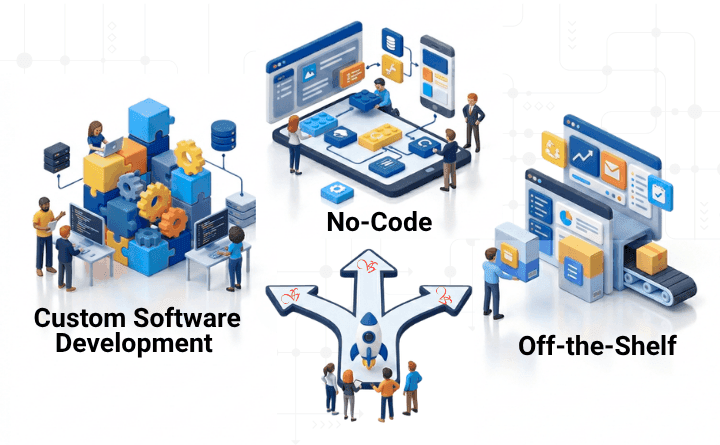
Startups rarely need one pure path. Some should buy off-the-shelf SaaS. Some should launch a no-code MVP. Some need custom application development from the start. Many should combine all three.
The practical rule is simple: buy what is standard, no-code what is uncertain, and custom-build what is core. Rebuild when real traction exposes limits in performance, ownership, data control, or workflow complexity.
This guide compares custom builds, no-code MVPs, SaaS tools, and hybrid approaches across validation stage, budget, scalability, intellectual property, data needs, and investor expectations.
What Is custom software development?
Custom software development is the process of designing, building, and maintaining software for a specific business model, workflow, user group, or product strategy. Unlike off-the-shelf tools, custom software is built around unique requirements, integrations, data needs, and growth plans. For startups, it is most valuable when the product itself creates differentiation.
In plain terms, custom software development gives a startup more control. That control can include product logic, user experience, architecture, data ownership, security decisions, and future roadmap flexibility.
Luxoft describes custom development as building bespoke digital solutions with security, compliance, and user experience in mind. Intellias similarly positions custom software development as full-stack engineering for complex business needs. Those descriptions matter because startups often face the same tradeoff as larger companies: speed today versus flexibility tomorrow.
When is custom software development the right choice?
Custom software development is the right choice when the core product, data model, workflow, or user experience cannot be created well with existing tools. It also fits startups that need defensible intellectual property, advanced integrations, regulated data handling, or scalable architecture before selling to larger customers.
A startup should lean custom when software is the business, not just business support. A marketplace matching engine, AI workflow layer, patient-data platform, fintech risk engine, or enterprise automation product may need custom logic from day one.
Custom development also becomes important when investor conversations shift from “Can this idea work?” to “Can this company scale?” Investors do not always require custom code. They usually care more about validation, defensibility, technical readiness, and whether the team controls the core asset.
Has anyone here worked with a custom software ...
Founders often ask whether anyone has worked with a custom software development partner because the decision feels high-stakes. The better question is not whether custom development works. The better question is whether the partner understands startup software development, MVP development, tradeoffs, and speed-to-learning.
A strong partner should help decide what not to build. That is especially important for early-stage teams. Building every feature from scratch can waste runway. Buying everything can weaken differentiation. A practical partner should separate core product logic from commodity workflows.
Mpowered Ventures positions its model around a “complete tech department” from concept to MVP to scale, including development, infrastructure, and AI support. Its About page also describes centralized product and project management in the United States, led by founder Mary Massoumi, with a global freelance network. That type of structure reflects a common startup need: senior technical direction without hiring a full in-house team too early.
How should startups evaluate a custom software partner?
Startups should evaluate a custom software partner by product judgment, technical architecture, communication, delivery process, and ability to support future scale. A vendor that only accepts requirements may build the wrong thing efficiently. A better partner challenges assumptions, protects runway, and keeps validation at the center.
Use these filters before committing:
- Startup fluency: Has the team built MVPs, prototypes, and scalable products?
- Product thinking: Can they reduce scope without weakening the value proposition?
- Technical judgment: Can they explain architecture choices in business language?
- Ownership clarity: Who owns the source code, designs, data, and documentation?
- Process discipline: How are backlog, testing, deployment, and support handled?
- Scale readiness: Can the system evolve after early customers arrive?
The best answer to “Has anyone worked with a custom software company?” is evidence-based. Review shipped work, ask for architecture examples, inspect communication habits, and confirm ownership terms before development begins.
Custom Software Development Services
Custom software development services can include discovery, product strategy, UX design, application development, cloud infrastructure, AI implementation, integrations, testing, deployment, and maintenance. For startups, the most useful services are those that move from validation to launch without locking the team into unnecessary complexity.
Services should match the startup stage. A pre-seed founder does not need the same build plan as a revenue-stage B2B SaaS company. A regulated product does not need the same path as a simple consumer prototype.
Which development path fits each startup stage?
The right path depends on the amount of validation already achieved. Early uncertainty favors no-code and SaaS. Repeated usage, paying customers, complex workflows, or strategic data usually justify custom application development. Hybrid approaches often bridge the gap between speed and control.
| Startup stage | Best-fit approach | Why it works | Watch-outs |
|---|---|---|---|
| Idea exploration | Off-the-shelf SaaS plus lightweight prototypes | Fastest way to test workflow and demand | Avoid mistaking internal setup for product validation |
| Problem validation | No-code MVP or clickable prototype | Tests user behavior before major engineering spend | Platform limits can distort product design |
| Early MVP | Hybrid no-code plus custom components | Preserves speed while adding unique logic | Integration debt can grow quickly |
| Validated product | Custom software development | Supports differentiation, data control, and scale | Requires disciplined scope and architecture |
| Regulated or data-heavy product | Custom-first or custom-heavy hybrid | Better fit for security, compliance, and audit needs | Needs experienced technical leadership |
| Enterprise-facing product | Custom or hybrid with robust integrations | Supports procurement, permissions, and reliability needs | Enterprise requirements can expand scope |
This framework keeps the decision grounded. Validation stage should lead the technical strategy. Budget and speed matter, but they should not override the role of the software in the business model.
How do budget and speed affect the decision?
No-code and SaaS usually reduce upfront effort. Custom software development usually increases upfront planning and engineering work. The tradeoff is long-term control. A cheaper launch can become expensive if the platform blocks needed features, integrations, analytics, or ownership.
A startup should not compare only build cost. It should compare total cost of learning and total cost of change. If a no-code MVP can validate demand in weeks, it may be the right first move. If rebuilding later would interrupt revenue or customer trust, a custom foundation may be safer.
Custom Software Development Company: Our Services & ...
A custom software development company should not be judged only by its service menu. The more important question is how it helps a startup decide between custom, no-code, SaaS, and hybrid delivery. Services are useful only when they support the business stage and product risk.
For a startup, the best development company acts like a product-minded technical team. It helps define what is core, what is commodity, and what should wait.
What should a startup expect from a development process?
A startup should expect a clear software development process that starts with discovery, narrows scope, validates assumptions, and ships in manageable releases. The process should include product strategy, design, engineering, quality assurance, deployment, and post-launch iteration. Agile software development is useful when feedback changes priorities.
A practical startup software development process often includes:
- Discovery: Define users, jobs-to-be-done, constraints, and success metrics.
- Scope shaping: Separate must-have MVP features from later roadmap items.
- UX and prototyping: Turn the workflow into screens, flows, and user journeys.
- Architecture planning: Choose stack, integrations, data model, and infrastructure.
- MVP development: Build the smallest reliable version that proves the core value.
- Testing and launch: Test workflows, security basics, performance, and analytics.
- Iteration: Improve based on usage, customer feedback, and operational needs.
LeewayHertz’s overview of custom software development emphasizes that custom solutions are built around specific business requirements. That idea is especially relevant for startups because requirements change quickly after real users arrive.
What belongs in the first MVP build?
An MVP should include only the features needed to prove the riskiest product assumption. It should not include every dashboard, automation, role, integration, or edge case. Good MVP development gives users enough value to behave realistically and gives the startup enough evidence to decide the next move.
The first build should focus on:
- One clear user segment
- One core workflow
- One measurable outcome
- Basic analytics
- Essential security and data protection
- A feedback loop
- A roadmap for what happens if validation succeeds
This keeps custom application development from becoming a long, expensive guessing exercise.
Best Custom Software Development Services Reviews 2026
The best custom software development services in 2026 will not be the ones with the longest feature list. They will be the ones that help startups choose the right build path, protect ownership, integrate AI thoughtfully, and scale without overbuilding. Reviews should focus on decision quality, not just delivery claims.
A useful review process compares providers by startup fit. Enterprise engineering firms such as Luxoft and Intellias demonstrate the mature end of the custom software market, with emphasis on full-stack delivery, security, compliance, and enterprise-grade systems. Startup-focused teams may offer more flexible engagement models and tighter MVP support.
What criteria should matter in reviews?
Reviews should examine evidence of delivery, ownership terms, product strategy, architecture quality, communication, and post-launch support. Pricing matters, but it should not be the only criterion. A low-cost build that cannot be maintained is not a good startup investment.
Use this review checklist:
| Criterion | What to look for | Why it matters |
|---|---|---|
| Product judgment | Clear MVP scoping and prioritization | Prevents overbuilding |
| Technical depth | Architecture, integrations, testing, deployment | Reduces rebuild risk |
| Startup experience | Work across concept, MVP, and scale | Matches changing needs |
| Ownership terms | Source code, IP, data, documentation | Protects future fundraising and flexibility |
| Communication | Transparent backlog, demos, decisions | Improves execution speed |
| Security mindset | Authentication, permissions, data practices | Supports trust and procurement |
| Maintenance plan | Monitoring, fixes, iteration support | Keeps the product usable after launch |
A provider review should also include a build-versus-buy conversation. If a company recommends custom development for every problem, the advice may be biased. If it recommends no-code for every problem, the advice may ignore scale and ownership.
What is a custom software development?
A custom software development project creates software for a specific organization, product, or user workflow. It usually includes planning, design, coding, testing, deployment, and maintenance. For startups, custom development is most useful when unique product logic, proprietary data, or specialized user experience is central to the company’s value.
This is different from off-the-shelf SaaS. SaaS tools are prebuilt products used by many companies. They are often best for standard needs such as accounting, email, CRM, scheduling, support, analytics, or internal operations.
No-code platforms sit between SaaS and custom code. They allow teams to create apps, workflows, forms, dashboards, and automations with minimal traditional coding. They are valuable for early validation, internal tools, and simple MVPs.
When should startups use no-code MVPs?
Startups should use no-code MVPs when the main risk is market demand, not technical feasibility. No-code works well for landing-page tests, concierge MVPs, simple marketplaces, internal workflows, data collection, scheduling flows, and prototypes that need fast user feedback.
No-code is less suitable when the product needs complex logic, high performance, deep customization, strict data controls, advanced AI infrastructure, or proprietary algorithms. It can also become limiting when user growth exposes platform constraints.
When is off-the-shelf SaaS faster and cheaper?
Off-the-shelf SaaS is faster and cheaper when the workflow is common and does not create strategic differentiation. Buying software for finance, HR, email, analytics, help desk, or basic CRM usually makes more sense than building it. Startups should save custom engineering for the parts customers actually value.
SaaS becomes risky when it forces the product to behave like everyone else’s. It can also create data silos, integration gaps, or pricing pressure as usage grows. The decision should be based on whether the workflow is commodity or core.
How do hybrid approaches work?
Hybrid approaches combine SaaS, no-code, and custom code in one product strategy. A startup might use SaaS for payments, no-code for admin workflows, and custom software for the customer-facing product. This approach often gives the best balance of speed, control, and learning.
Hybrid development is useful when a startup has some validated needs but not enough certainty to custom-build everything. The key is to avoid accidental architecture. Integrations, data flows, and ownership boundaries should be planned early.
What is the 40 20 40 rule in software engineering?
The 40-20-40 rule is an informal planning heuristic, not a universal software engineering standard. It is commonly used to remind teams that successful software depends heavily on discovery and validation, not only coding. A startup can interpret it as 40% understanding the problem, 20% building, and 40% testing, launch, and iteration.
For startup software development, the spirit of the rule is useful. Many product failures come from building the wrong thing too confidently. More time spent clarifying users, workflows, pricing assumptions, and adoption barriers can reduce wasted development effort.
How should startups apply this rule to build decisions?
Startups should use the 40-20-40 mindset to avoid premature custom builds. If the problem is unclear, start with interviews, prototypes, SaaS workflows, or no-code MVPs. If the workflow is validated and central to differentiation, shift more investment into custom application development.
A simple interpretation works well:
- Before building: Define the user, pain, workflow, and success metric.
- During building: Keep scope narrow and release quickly.
- After launch: Measure behavior, support users, and iterate.
This approach supports better technical decisions because it treats software as a learning system, not a one-time asset.
What are the 7 phases of SDLC?
The seven common phases of the software development life cycle are planning, requirements, design, development, testing, deployment, and maintenance. Different teams name these phases differently, but the core idea is consistent: software should move from problem definition to release through a structured, testable process.
For startups, SDLC should be lightweight but not careless. Too much process slows learning. Too little process creates fragile software, unclear ownership, and expensive rework.
How does SDLC change for MVP development?
In MVP development, SDLC should compress around the riskiest assumption. Planning and requirements should focus on the smallest valuable workflow. Design should make that workflow understandable. Development should avoid unnecessary features. Testing should protect the core experience. Deployment should include analytics and feedback collection.
A startup-friendly SDLC looks like this:
- Plan the assumption: What must be true for this product to work?
- Define requirements: What must users be able to do?
- Design the workflow: What is the simplest path to value?
- Build the MVP: What proves the core behavior?
- Test the experience: What could block adoption or trust?
- Launch to a focused group: Who can provide useful feedback?
- Maintain and iterate: What should change based on evidence?
This structure works for custom, no-code, SaaS, and hybrid builds. The level of engineering changes, but the discipline stays useful.
What is the 80 20 rule in software development?
The 80/20 rule in software development is the idea that a small share of features often creates most user value. It is a prioritization heuristic, not a fixed law. For startups, it means the first build should focus on the few workflows that prove demand and retention.
This rule is especially useful when comparing custom software development, no-code, and SaaS. A startup may discover that 80% of user value comes from one workflow. That workflow may deserve custom investment, while surrounding features can remain SaaS-based or manual.
What red flags indicate a rebuild is needed?
A rebuild is needed when the current system blocks growth, weakens user trust, or prevents the product from evolving. Rebuilds should not happen because a team wants cleaner code. They should happen when technical constraints create business constraints.
Common rebuild red flags include:
- Users experience slow performance during core workflows.
- The platform cannot support required features.
- Data is trapped, fragmented, or hard to analyze.
- Security, permissions, or audit needs exceed platform limits.
- Integrations break often or require manual workarounds.
- Enterprise customers ask for controls the system cannot support.
- Investors or partners raise reasonable questions about technical readiness.
- The team spends more time patching than learning or shipping.
A rebuild does not always mean starting over. Sometimes the right move is replacing one no-code workflow with custom code, moving data into a better structure, or rebuilding the core product while keeping SaaS tools around it.
What decision tree should startups use?
Startups should decide by asking whether the workflow is core, validated, scalable, and sensitive from a data or IP perspective. If the answer is no, SaaS or no-code may be enough. If the answer is yes, custom software development should be considered.
Use this practical decision tree:
- Is the workflow standard?
- Yes: Buy SaaS.
- No: Continue.
- Is the customer need still unvalidated?
- Yes: Use no-code, prototype, or concierge MVP.
- No: Continue.
- Is this workflow central to differentiation?
- No: Use SaaS or no-code.
- Yes: Continue.
- Does the product need proprietary data, IP, or complex logic?
- Yes: Build custom.
- No: Consider hybrid.
- Will platform limits hurt scale, security, or enterprise sales?
- Yes: Build or rebuild custom.
- No: Keep the simpler path until evidence changes.
How do common startup scenarios compare?
Different startup scenarios need different build strategies. The best choice depends on validation, risk, and differentiation.
- Validated B2B workflow: Use custom software development for the core workflow. Use SaaS for billing, CRM, and support.
- Early consumer MVP: Use no-code or a lightweight hybrid. Focus on activation and retention signals.
- Regulated or data-heavy product: Lean custom earlier. Prioritize permissions, auditability, and data architecture.
- Enterprise-facing SaaS: Use custom or hybrid. Plan for integrations, roles, security reviews, and reliability.
- AI-enabled product: Build custom where model workflow, data pipeline, or user experience creates differentiation. Use existing tools for non-core operations.
The strongest approach is rarely ideological. It is staged, practical, and tied to the business model.
FAQ
What is a custom software development?
Custom software development is building software for a specific business, product, or workflow. It differs from SaaS because the solution is tailored rather than prebuilt for many users. Luxoft and Intellias both describe custom development as bespoke engineering for specific business requirements, often including design, development, deployment, and support.
What is the 40 20 40 rule in software engineering?
The 40-20-40 rule is an informal heuristic, not a formal engineering standard. Startups can use it as a reminder to spend meaningful effort on problem discovery, focused building, and post-launch testing. It supports better MVP development by reducing the risk of building before the product need is clear.
What are the 7 phases of SDLC?
The seven common SDLC phases are planning, requirements, design, development, testing, deployment, and maintenance. Teams may use different labels, but the sequence helps keep software work structured. For startups, the process should stay lightweight while still protecting quality, ownership, and learning after launch.
What is the 80 20 rule in software development?
The 80/20 rule is a prioritization idea suggesting that a small number of features often create most user value. In startup software development, it helps teams avoid overbuilding. The practical goal is to identify the core workflow users need most, then build only enough to validate it.
Is no-code good enough for a startup MVP?
No-code can be good enough when the startup is testing demand, workflow, or user behavior. It is less suitable for complex logic, strict data control, proprietary algorithms, or high scalability needs. A no-code MVP should be treated as a learning tool, not always the final product architecture.
When should a startup choose SaaS instead of custom development?
A startup should choose SaaS when the workflow is common and not central to differentiation. Examples include accounting, email, CRM, customer support, and scheduling. SaaS is usually faster to adopt than custom application development, but it may create limits around customization, data flow, or long-term control.
Do investors prefer custom software development?
Investors do not universally prefer custom software. They usually look for validation, defensibility, technical readiness, IP clarity, and the ability to scale. Custom development can help when the product’s core value depends on proprietary workflows or data. No-code can still be acceptable for early validation.
Conclusion
Custom software development, no-code MVPs, off-the-shelf SaaS, and hybrid approaches all have a place in startup software development. The right decision depends on stage, validation, budget, speed, scalability, IP, data needs, and investor expectations.
The clearest rule is practical: buy what is standard, no-code what is uncertain, and custom-build what is core. SaaS is usually best for commodity operations. No-code is often best for early learning. Custom development is strongest when the product itself creates differentiation, requires control, or must scale beyond platform limits.
A startup does not need to overbuild to look serious. It needs a technical path that matches the evidence it has today and the company it is trying to become. The strongest teams make that decision deliberately, then revisit it as traction reveals what the product truly needs.
Stay updated on tech trends
Join our mailing list for exclusive insights and practical tech advice delivered to your inbox.
For Businesses
Need expertise on your next technical challenge? our team is here to help.
Mary Massoumi
Mary Massoumi
Marketing Director (15+ years) exploring new tools/techniques. Daily insights on AI, MarTech, social media & ads
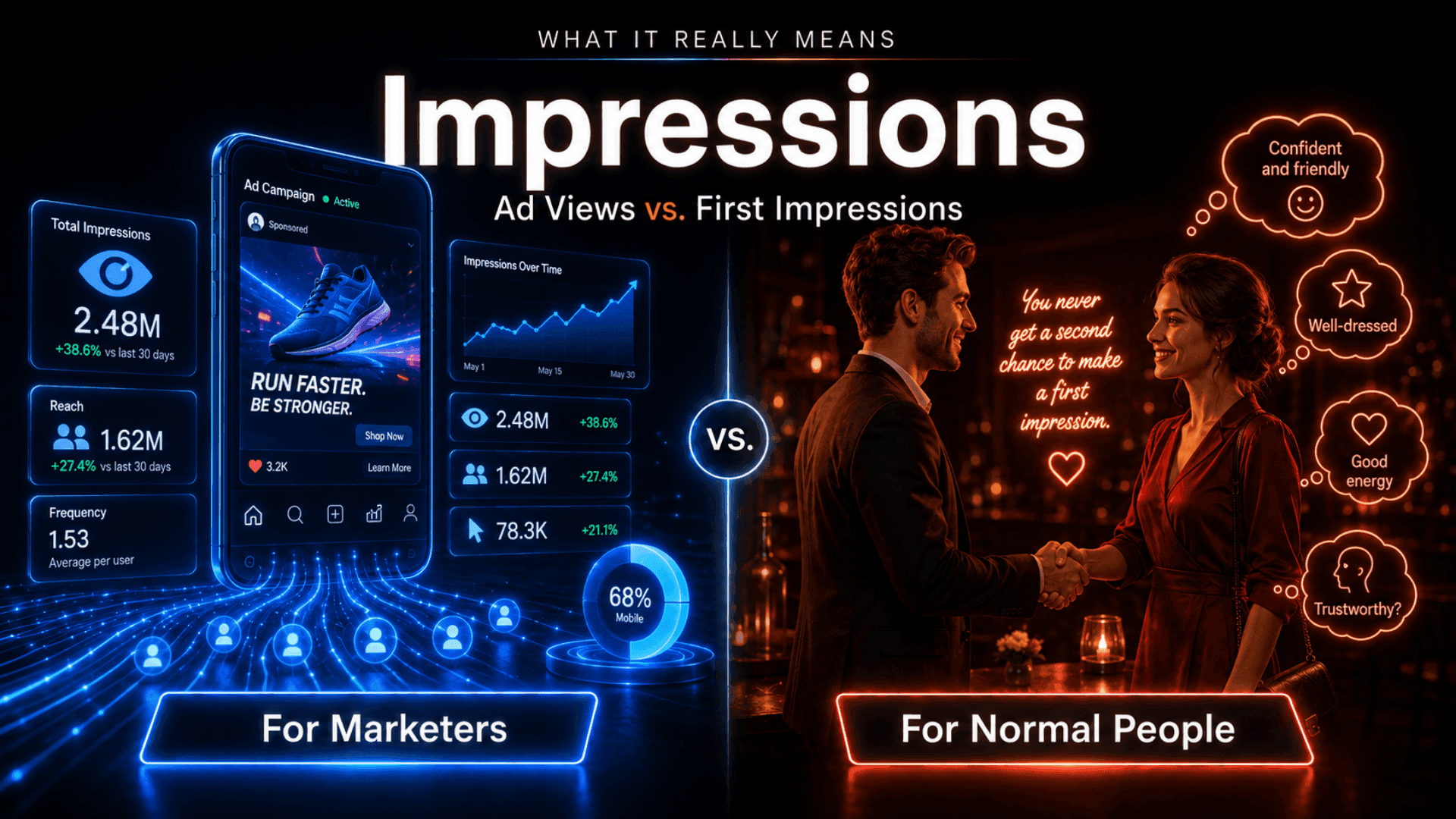
Impressions: Ad Views vs. First Impressions — What It Really Means for Marketers vs. Normal People
Posted by Mary Massoumi |.August 30 2026

Traffic: Homepage Hits vs.Headache-What It Really Means for Marketers vs. Normal People
Posted by Mary Massoumi |.March 22 2026
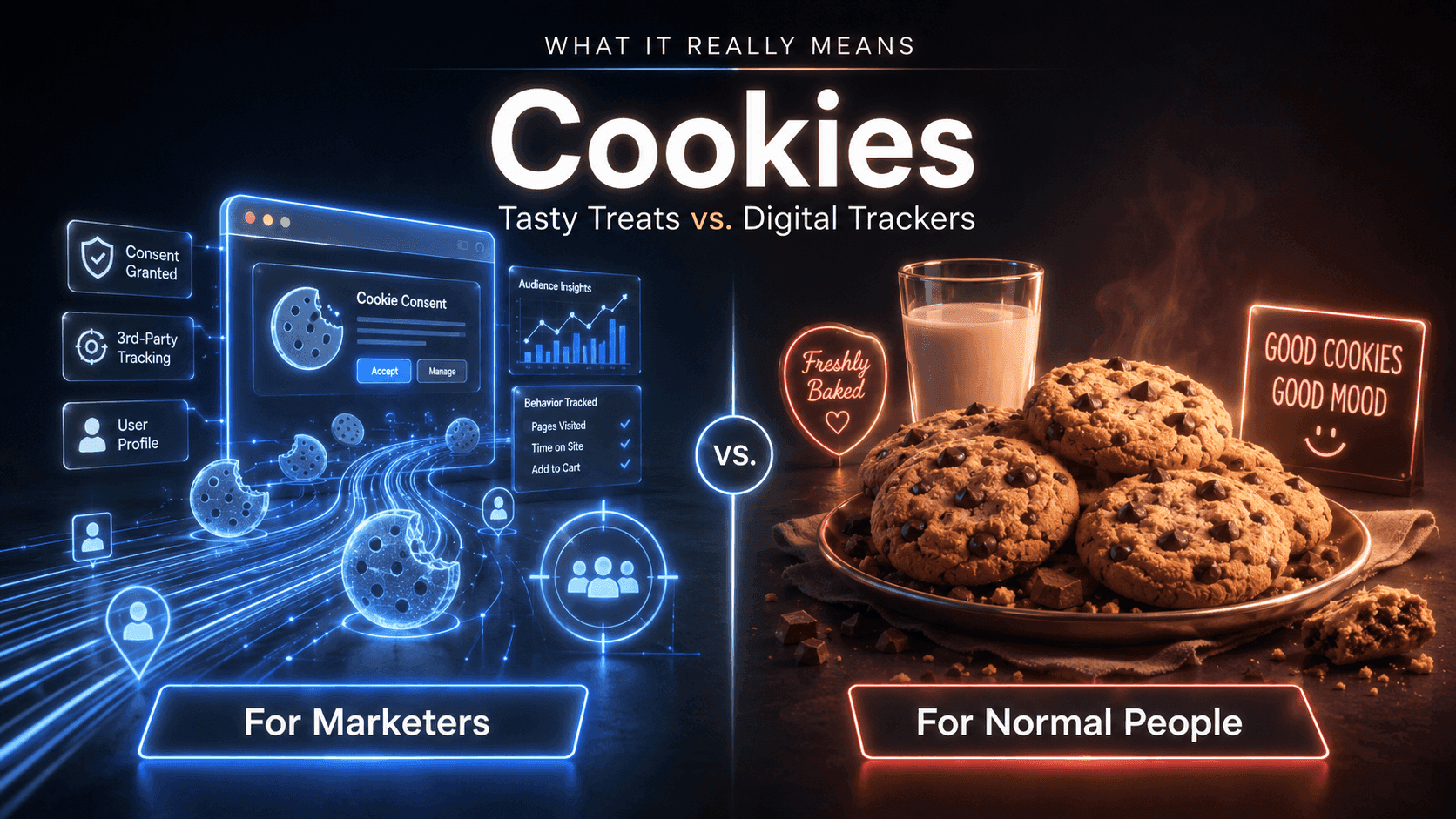
Cookies: Tasty Treats vs. Digital Trackers-What It Really Means for Marketers vs. Normal People
Posted by Mary Massoumi |.March 22 2026
You May Also Like
M Powered Ventures supports startups and companies by providing world-class tech expertise.
Have questions about implementing these ideas?
We're here to help.Contact Usfor a free consultation orPitch Your Startupif you're looking for a technical co-founder.
