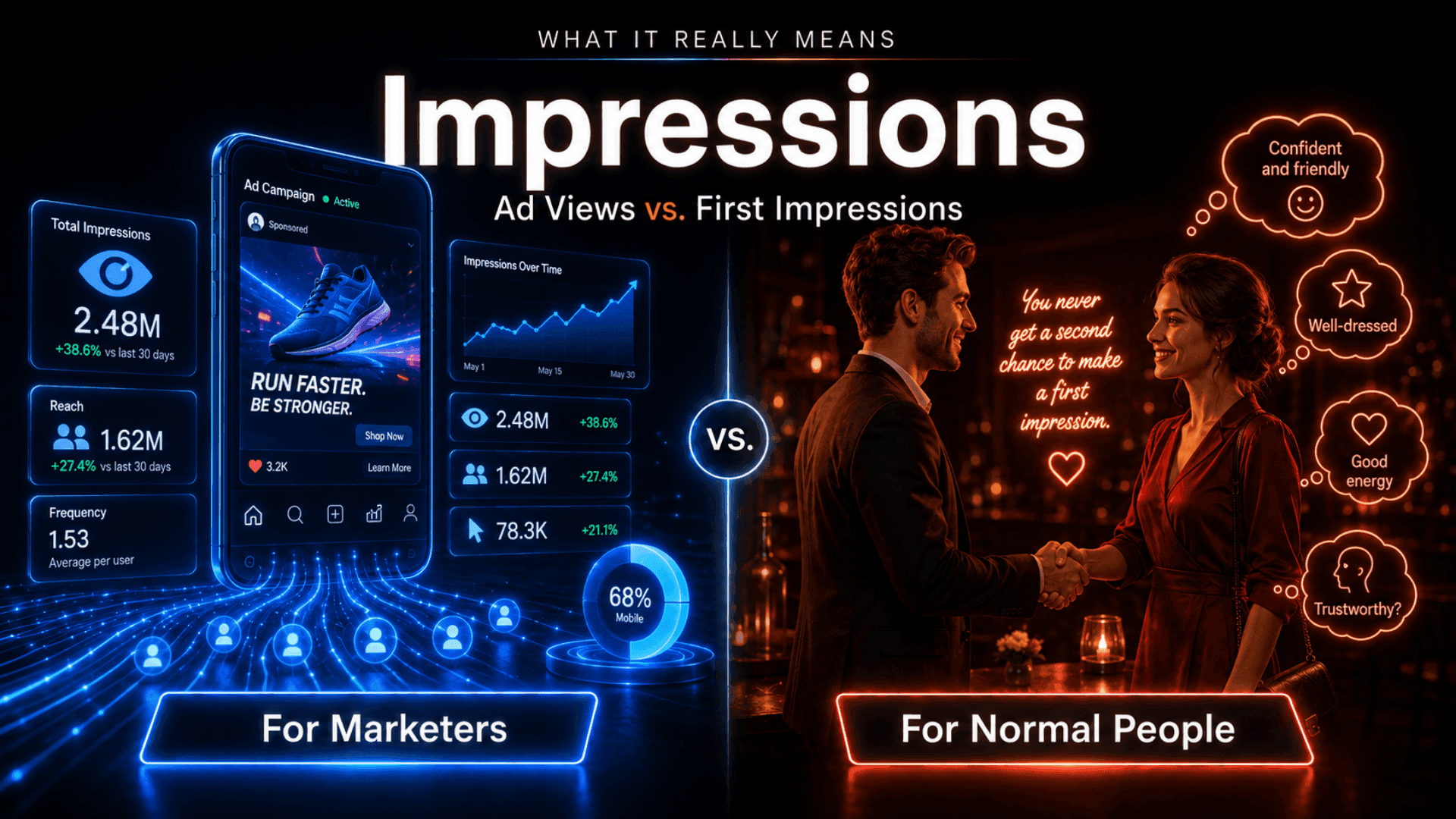

Marketers vs. Normal People


The other morning, I met someone for coffee for the first time. Within about thirty seconds, I had already formed an impression. They were friendly. They laughed easily. They remembered my name. Good first impression. Then they ordered a $14 oat-milk latte and spent five minutes explaining why regular milk was “emotionally complicated.” My impression changed. That got me thinking about one of the funniest words in marketing: impression. To normal people, an impression is what you think about someone after meeting them. It can happen in seconds. It can be positive, negative, memorable, or completely wrong. To marketers, an impression is a number. “Great news! We generated 2.4 million impressions this month!” Meanwhile, the average person is thinking: “Okay… did anyone actually see the ad?” And honestly, that is a very good question.
1. The First Impression That Started It All
Think about meeting someone for the first time.
You notice their handshake, their clothes, their smile, whether they make eye contact, and—whether you admit it or not—whether they seem like someone you'd want to talk to again. That's a first impression. Marketing has a remarkably similar concept, except we put it into a dashboard. A person scrolls through Instagram and your ad appears. An impression is recorded. A banner loads on a website. Another impression. A video starts playing while someone is looking for the “Skip Ad” button. Impression. The marketer celebrates. The normal person says: “I wasn't even looking at that.” And technically, both can be right.
2. Impressions: Personal Judgment vs. Marketing Metric
Normal People & Impressions
For regular humans, an impression is personal. You meet someone and think:
- “I like them.”
- “Something feels off.”
- “They seem really smart.”
- “They talk about themselves way too much.”
- “I need to introduce them to my friend.”
The impression happens inside your head. Nobody needs to count it. Nobody needs a dashboard. Nobody says: “We achieved a 72% positive impression rate at dinner.” Thankfully.
Marketers & Impressions
For marketers, impressions are measurable.
An impression generally represents an instance where an advertisement is delivered and begins rendering on a page, app, or other digital environment. That sounds simple. But here's the important distinction: An impression does not necessarily mean someone actually noticed the ad. An ad can load at the bottom of a webpage while the user is reading something at the top. It can appear while someone is scrolling past at full speed. It can technically be visible while the person is making a sandwich. The ad gets its impression. The person gets their sandwich. Everyone wins. Well… except perhaps the advertiser.
3. The Difference Between “Served” and “Seen”
This is where marketing terminology gets wonderfully complicated. The advertising industry has developed the concept of viewability to get closer to answering the question marketers actually care about: Did the ad have a real opportunity to be seen? Under the commonly used IAB/MRC standard, a display ad is considered viewable when at least 50% of its pixels are visible for at least one continuous second. For video, the threshold is generally 50% visible for at least two continuous seconds. So imagine this: Your ad is served. The impression counts. But the user never scrolls far enough to see it. That's an impression—but not a viewable impression. Now imagine the ad appears on screen for one second. It may qualify as viewable. But did the person actually read your headline? Did they understand your offer? Did they remember your brand? Did they even care? We don't necessarily know. Google itself points out that viewability can tell marketers whether an ad was in a position where it could be seen, but it cannot guarantee that the user was actually looking at the screen. That's a pretty important distinction. Viewable doesn't mean noticed, noticed doesn't necessarily mean remembered, remembered doesn't necessarily mean liked, and liked doesn't necessarily mean purchased. Welcome to marketing.
4. Why Marketers Love Big Impression Numbers
There is something psychologically satisfying about a giant number. 10,000 impressions? Nice. 100,000? Better. 1 million? Now we're putting it in the presentation. 10 million? Someone is probably making a slide titled: “Massive Brand Awareness Growth.”
And sometimes, that's justified. Impressions are useful because they tell marketers how often advertising was delivered. They help measure reach and frequency, compare campaigns, calculate CPM, and understand how much exposure a brand is buying. But impressions become dangerous when they are treated as the final answer. Imagine a restaurant saying: “We served 50,000 menus this month!” Okay, but how many people ordered? Or a dating app saying: “Your profile appeared 200,000 times!” Great.
But how many people swiped right? Or a business saying: “We handed out 100,000 business cards!” Wonderful. How many people called Exposure is not the same thing as impact.
5. First Impressions Work the Same Way
Here's where the everyday meaning becomes surprisingly useful. Imagine you walk into a store. The lights are harsh. The music is terrible. Nobody acknowledges you. The shelves are messy. You leave. The store technically gave you an “impression.” But it wasn't a good one. Digital marketing works the same way. Your ad can generate millions of impressions while creating very little positive memory. That's because the quality of the impression matters. A beautiful ad in the wrong context may be ignored. A clever ad shown to the wrong audience may be irrelevant. A perfectly targeted ad with terrible creative may be annoying. And an ordinary-looking ad with the right message at exactly the right moment can outperform everything else. In other words: Not every impression is an impression worth having.
6. The Marketer's Impression Problem
One of the biggest mistakes marketers can make is treating impressions as if every impression has equal value. They don't. Consider two campaigns.
Campaign A
1,000,000 impressions $10 CPM Low viewability Weak engagement Almost no conversions
Campaign B
250,000 impressions $20 CPM Strong viewability High engagement Significant conversions
Which campaign is better? If you're looking only at the biggest number, Campaign A wins. If you're looking at business results, Campaign B may be the clear winner. This is why impressions should usually be considered alongside other signals:
- Reach
- Frequency
- Viewability
- Click-through rate
- Engagement
- Conversion rate
- Cost per acquisition
- Incremental sales
- Brand lift
- Attention and creative quality
The impression is the beginning of the story—not the ending.
7. When an Impression Becomes a Real Impression
Think about the people you remember meeting. You probably don't remember everyone you've encountered this month. You remember the person who made you laugh. The person who helped you. The person who said something surprising. The person who had an unforgettable story. The same principle applies to advertising. A consumer may be exposed to thousands of marketing messages, but only a small number actually become memorable. That's why great marketing isn't simply about getting seen. It's about being worth noticing.
The goal isn't:
“How many times did our ad appear?”
The better question is:
“How many meaningful opportunities did we create for someone to remember us?”
That's a much harder metric. It's also much more useful.
8. Marketers' Impression Playbook
So what should marketers actually do with all these impressions?
Measure viewability, not just delivery
If your campaign reports millions of impressions, look at how many were actually viewable. A served impression tells you the ad was delivered. A viewable impression tells you it had an opportunity to be seen. Neither guarantees attention—but the second gets you closer.
Stop worshipping the biggest number
A campaign doesn't automatically become successful because its impression count has more zeros. Ask what happened after exposure.
Did people click?
Did they engage?
Did they visit your site later?
Did sales increase?
Did brand awareness improve?
Make the first second count
People don't owe your advertisement their attention.
You have to earn it. Strong creatives should communicate the core idea quickly.
Clear headline.
Strong visual.
Relevant message.
Obvious value.
No seven-paragraph explanation disguised as a banner ad.
Match the message to the audience
An impression from the wrong audience isn't necessarily valuable. Showing luxury luggage to someone who never travels isn't great targeting. Showing a retirement-planning ad to a college student may not be catastrophic, but it's probably not your best use of money. The more relevant the message, the more likely an impression becomes meaningful.
Think beyond the impression
Use impressions as the first layer of measurement. Then ask:
Did they see it?
Did they notice it?
Did they remember it?
Did they care?
Did they act?
That's the journey from an ad impression to a business outcome.
9. Myth vs. Fact: Impression Edition
Myth: “An impression means someone saw my ad.”
Fact: Not necessarily. An ad can be served without being visible to the user. Viewability standards exist specifically to distinguish impressions that had an opportunity to be seen from those that did not.
Myth: “A viewable impression means someone paid attention.”
Fact: No. Viewability measures whether the ad met certain visibility and time thresholds. It does not prove that a human was actually looking at it.
Myth: “More impressions always mean better marketing.”
Fact: More exposure can be valuable, but relevance, frequency, creative quality, viewability, engagement, and conversions matter too.
Myth: “If people don't click, the ad failed.”
Fact: Not necessarily. Advertising can influence awareness and consideration without generating an immediate click. The right success metric depends on the campaign objective.
Myth: “First impressions and ad impressions have nothing in common.”
Fact: They have more in common than marketers might realize. Both are about exposure, perception, and what happens next.
10. The Real Meaning of an Impression
The funny thing about the word “impression” is that marketers turned something deeply human into a spreadsheet metric.
Normal people think: “What's my impression of this person?”
Marketers think: “How many impressions did the campaign generate?”
But underneath both definitions is the same fundamental idea:
Something was put in front of you, and something might happen because of it.
Maybe you remember it.
Maybe you ignore it.
Maybe you love it.
Maybe you hate it.
Maybe you click.
Maybe you buy.
Maybe you simply scroll past while looking for a video of a dog falling off a couch. And that's why the smartest marketers don't stop at impressions. They ask what the impression actually did. Because in advertising, getting 1 million impressions sounds impressive. But creating 1 million meaningful moments? That's marketing.
Conclusion: Making an Impression
The next time someone tells you their campaign generated 5 million impressions, don't immediately ask how big the number is. Ask a better question: “What kind of impression did we make?”
Because in real life, you wouldn't judge a person by how many people happened to see them walk into a room. You'd judge them by what people thought after they arrived. Marketing isn't that different. An impression gets you into the room. A good message makes people look up. A memorable brand makes them remember you. And a great experience gives them a reason to come back. So here's to fewer vanity metrics and more meaningful impressions. And if your next campaign gets 10 million impressions, congratulations. Just make sure at least a few of them actually remember your name.
Stay updated on tech trends
Join our mailing list for exclusive insights and practical tech advice delivered to your inbox.
Other Blog Posts









For Businesses
Need expertise on your next technical challenge? our team is here to help.
Mary Massoumi
Mary Massoumi
Marketing Director (15+ years) exploring new tools/techniques. Daily insights on AI, MarTech, social media & ads
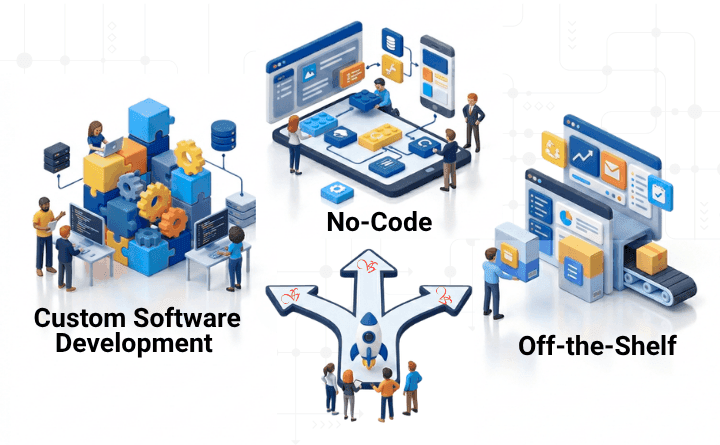
Custom Software Development vs. No-Code vs. Off-the-Shelf: How Startups Should Decide
Posted by Mary Massoumi |.June 11 2026
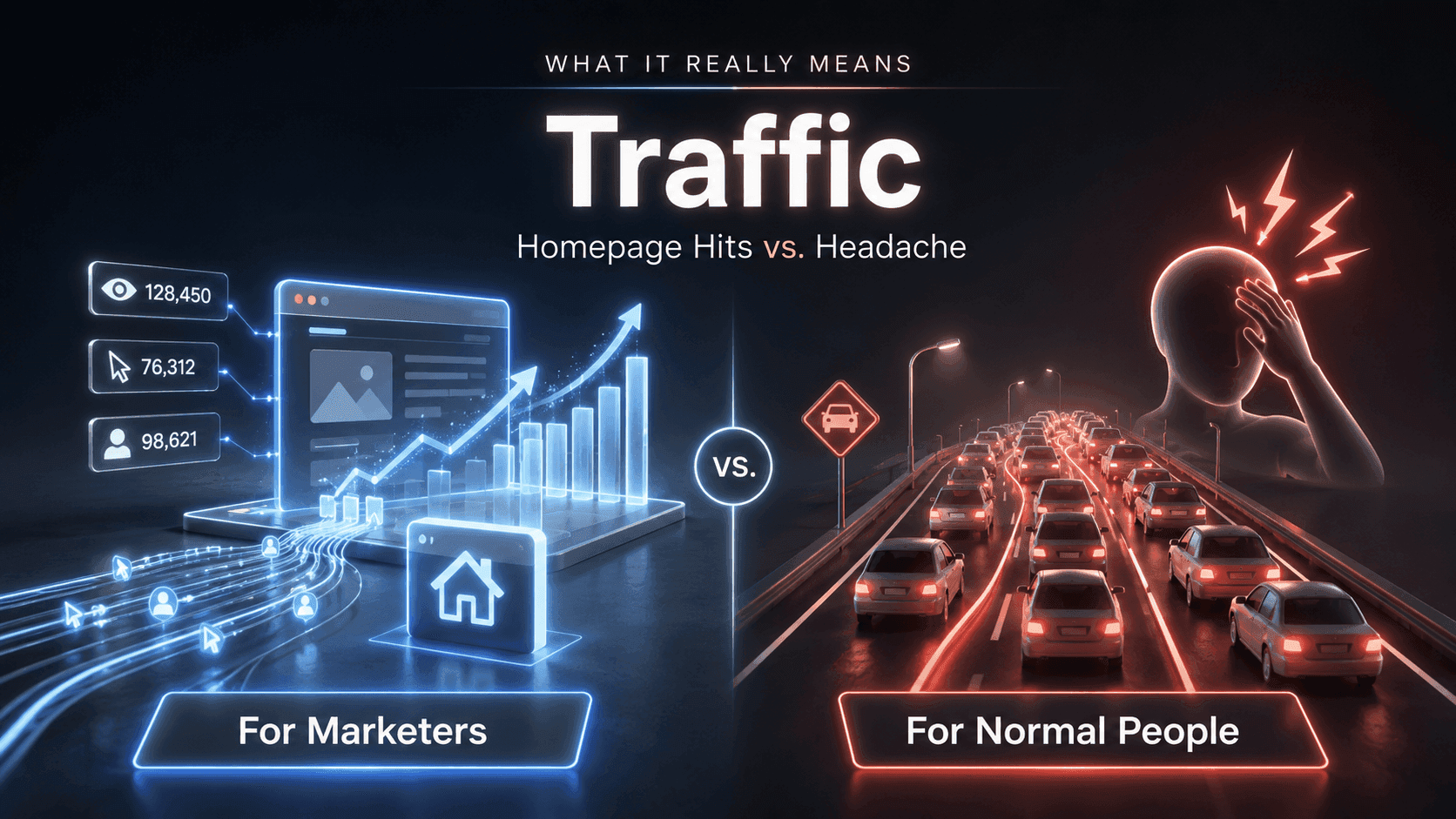
Traffic: Homepage Hits vs.Headache-What It Really Means for Marketers vs. Normal People
Posted by Mary Massoumi |.March 22 2026
Cookies: Tasty Treats vs. Digital Trackers-What It Really Means for Marketers vs. Normal People
Posted by Mary Massoumi |.March 22 2026
You May Also Like
M Powered Ventures supports startups and companies by providing world-class tech expertise.
Traffic: Homepage Hits vs.Headache-What It Really Means for Marketers vs. Normal People
A marketing director's humorous take on the dual meaning of "traffic" - exploring why marketers celebrate website traffic while everyone else dreads road traffic, plus 2025 web traffic trends and optimization strategies.
Mary Massoumi · March 22 2026 · 3
Cookies: Tasty Treats vs. Digital Trackers-What It Really Means for Marketers vs. Normal People
A humorous yet insightful exploration of how marketers and consumers view "cookies" differently. from chocolate chip treats to digital tracking technology, and how the cookieless future is reshaping digital marketing strategies.
Mary Massoumi · March 22 2026 · 7
When “Organic” Means Clicks vs. Kale: A Tale of Two Organic
A marketing director's humorous take on how "organic" means completely different things to health-conscious consumers (pesticide-free food) versus digital marketers (unpaid traffic and content). Discover the surprising similarities between growing kale and growing your brand naturally.
Mary Massoumi · March 22 2026 · 7
Have questions about implementing these ideas?
We're here to help.Contact Usfor a free consultation orPitch Your Startupif you're looking for a technical co-founder.
