
Insights


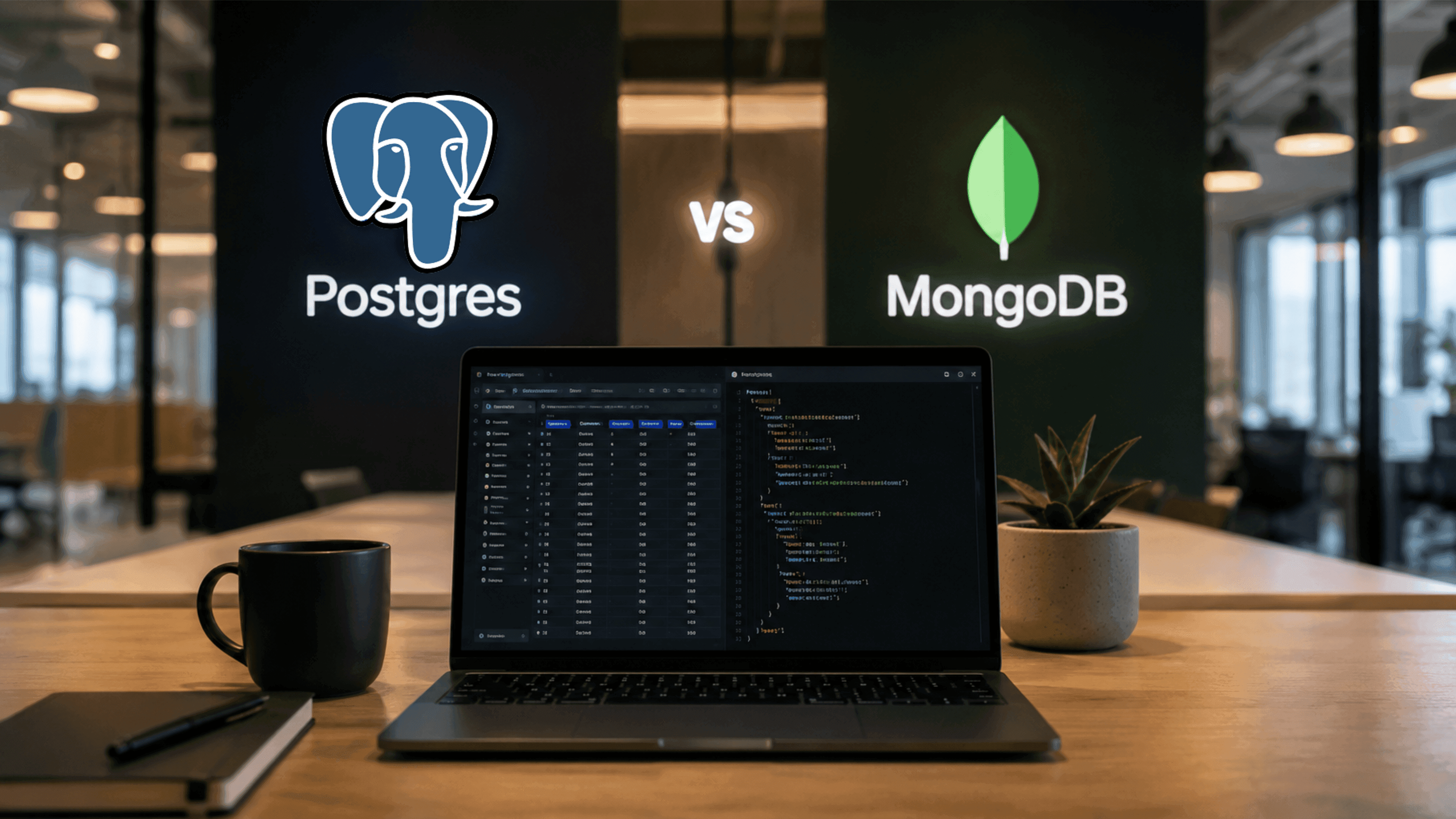
Postgres vs MongoDB Early Stage: Which Database Fits Your Startup?
Choosing your core technology determines your development velocity and operational runway. For early-stage founders navigating pre-seed and seed funding for tech startups, selecting a database is a critical structural decision. This architectural choice directly impacts how fast you can launch an MVP, control cloud costs, and scale your product to attract early adopters.
The decision typically comes down to two dominant engines: PostgreSQL (a robust relational SQL database) and MongoDB (a flexible, document-oriented NoSQL database). Each model represents distinct philosophy-driven trade-offs between schema flexibility, developer velocity, relational integrity, and total cost of ownership (TCO).
Developer Velocity vs. Schema Migrations
When building an MVP, developer velocity is your most valuable asset. The primary difference between these database engines lies in how they handle data structures:
- MongoDB (Document Model): Stores data as polymorphic, JSON-like BSON documents. It eliminates the friction of configuring complex Object-Relational Mapping (ORM) tools, allowing developers to map application code directly to database storage. Because it uses a dynamic "schema-on-write" approach, developers can save new data fields instantly without altering existing rules.
- PostgreSQL (Relational Model): Organizes data into structured tables, columns, and rows with strict schema enforcement. Changing your data structure requires writing and executing database migrations, which can slow down early prototyping.
To bridge this gap, modern PostgreSQL supports powerful "JSONB" columns, allowing teams to mix structured relational data with flexible JSON objects inside a single engine.
For non-technical founders, standardizing on a database without a plan can lead to structural messiness. Working with an experienced partner like Mpowered Ventures—acting as your dedicated technical co-founder—ensures your global engineering team balances early development speed with a clean database schema from day one.
Handling Relations: Complex SQL Joins vs. Embedded Documents
Your choice of database determines how your application connects related data points, such as linking a user to their subscription billing and transaction history:
- The Relational Approach (PostgreSQL): PostgreSQL enforces strict referential integrity using foreign keys. If a user deletes an account, the database natively ensures orphan transaction records are handled cleanly. To pull data across tables, it processes lightning-fast, native SQL joins.
- The Document Approach (MongoDB): MongoDB encourages embedding related data directly within a single document (e.g., storing a user's address history inside the user profile document). If data must span multiple documents, the application code must handle the relationship logic manually.
Many startups choose NoSQL to ship an MVP quickly, but as data models mature, writing complex relational logic in application code can introduce performance bottlenecks and bugs. Migrating those relations back to the database tier simplifies backend engineering and keeps data consistent.
[How Data Relations are Processed]
Postgres:  [Database Join Engine]     ───Natively Fast & Consistent──► Scaled Platform
NoSQL:     [Application Join Logic]  ───Requires Custom Code────────► High Risk of Bugs
At Mpowered Ventures, our startup engineering team designs migrate-proof database architectures, saving you from expensive database rebuilds after your product gains market traction.
Database Scaling: Serverless Postgres Branching vs. MongoDB Sharding
Scale requirements change drastically once you move past your MVP. However, the way these two platforms scale horizontally and vertically is vastly different:
- MongoDB Sharding: Designed from the ground up for horizontal scale-out. It distributes massive data sets across multiple servers (shards) automatically, making it ideal for high-volume catalogs and real-time event logging.
- Serverless Postgres Branching: Modern serverless PostgreSQL hosting has changed the landscape for startups. Platforms like Neon.tech allow you to split your compute and storage, providing instant, git-like database branching to test features in isolation without duplicating full-scale infrastructure costs.
At Mpowered Ventures, we leverage modern cloud infrastructure startup designs, utilizing Terraform and Kubernetes alongside advanced serverless database setups. This guarantees that your systems scale reliably while keeping initial cloud hosting bills minimal.
Operational Simplicity and Early-Stage Infrastructure Footprint
Early-stage startups must optimize for operational simplicity. Managing multiple specialized databases increases technical debt and developer overhead.
PostgreSQL is a highly robust, multi-model engine that can act as a relational database, a document store, and an AI vector database simultaneously. By using PostgreSQL as a multi-model default, your startup avoids the complexity of deploying and maintaining separate database systems for different features.
Through our startup tech partner model, Mpowered Ventures handles your entire cloud infrastructure lifecycle, establishing a simplified technical footprint so your core team can focus entirely on fundraising and user acquisition.
Vector Search Capabilities (pgvector vs. MongoDB Atlas Vector Search)
AI-readiness is a major consideration for modern software startups. Both database systems have integrated powerful vector capabilities to support generative AI, Retrieval-Augmented Generation (RAG), and agentic workflows without requiring a separate vector database:
- PostgreSQL (pgvector): The pgvector extension allows startups to store and query high-dimensional vector embeddings right alongside standard relational user transactions. This prevents sync lag and keeps all application data in a single transactional database.
- MongoDB Atlas Vector Search: Built natively into MongoDB's cloud ecosystem, Atlas Vector Search is optimized for distributed architectures and dynamic JSON-like catalogs. It allows quick horizontal search scaling across globally distributed database clusters.
Our team provides elite ai-powered engineering to implement these vector engines seamlessly, matching your application requirements with the right LLM integrations.
Total Cost of Ownership (TCO) in Early-Stage Seed/Bootstrap Phases
Your early-stage database choice heavily impacts your cloud runway. Understanding the exact pricing dynamics of modern hosting platforms is key:
Neon Serverless PostgreSQL Pricing
- Compute Model: Pure usage-based billing using Compute Units (CUs), where 1 CU equals approximately 1 vCPU and 4 GB of RAM.
- Compute Cost: $0.106 per CU-hour on the Launch tier and $0.222 per CU-hour on the Scale tier. It includes true scale-to-zero capabilities, meaning you pay $0 for compute when your database is idle.
- Storage Cost: A flat $0.35 per GB-month.
- Branching Cost: You get 10 to 25 free database branches. Additional branches cost $1.50 per branch-month, prorated hourly. Because branches use copy-on-write storage, child branches start at $0 storage and only bill for unique data changes.
MongoDB Atlas Pricing (Serverless & M0-M30 Tiers)
- Compute Model: Standard MongoDB Atlas tiers (such as M0, M2, M5, or dedicated M10 to M30 clusters) utilize always-on virtual instances.
- Compute Cost: Billed as a fixed hourly rate based on instance size, even when there is zero user traffic. There is no native scale-to-zero compute pricing on these tiers.
- Branching & Testing Cost: MongoDB Atlas lacks native copy-on-write branching. Testing isolated features typically requires spinning up separate database instances, duplicating both the full compute hourly fee and storage costs.
For early-stage startups with intermittent developer or user traffic, serverless Postgres lowers operational overhead and cost barriers by scaling down to zero when idle. MongoDB Atlas is highly scalable for production workloads but can scale up hosting costs quickly when replication environments are needed.
At Mpowered Ventures, our US-based project leadership manages global engineering talent to deploy cost-optimized database stacks. We make sure you never pay for over-provisioned cloud servers, maximizing your seed funding.
Which Database Fits Your Startup Stack?
Your database decision should align with your business model and product roadmap:
| Choose PostgreSQL If: | Choose MongoDB If: |
|---|---|
| Your application processes payments, subscription billing, or financial transactions. | Your product handles rapidly changing JSON catalogs, content management, or real-time event feeds. |
| You require complex multi-table SQL joins and deep analytical reporting. | You want to store unstructured or polymorphic data without performing upfront schema migrations. |
| You want a highly resource-efficient, unified engine that handles relational, JSON, and vector data. | You are building a high-volume, write-heavy streaming application that needs easy horizontal sharding. |
Making this choice as a non-technical founder can be daunting. Mpowered Ventures serves as your complete tech department, offering an innovative technical co-founder model where we invest our execution in exchange for equity.
We don't just write code; we take on full CTO responsibilities. From initial mvp development and scalable cloud infrastructure architecture to data-driven growth marketing for small business, we align our technical execution with your business growth.
Partner with a trusted, women-owned tech company to build your foundation. Contact Mpowered Ventures today to discuss your product stack and launch your MVP.
Sources
- MongoDB For Startups — https://mongodb.com/solutions/startups
- Postgres vs MongoDB: Which is Better for Your Web App? — https://supabase.com/blog/postgresql-vs-mongodb
- Why Startups Choose Postgres Over MongoDB — https://neon.tech/blog/postgres-vs-mongodb-for-startups
Stay updated on tech trends
Join our mailing list for exclusive insights and practical tech advice delivered to your inbox.
Other Blog Posts














For Businesses
Need expertise on your next technical challenge? our team is here to help.
M Powered Ventures Editorial Team
Founder of startup x


M Powered Ventures Editorial Team
Founder of startup x
M Powered Ventures editorial team

Startup Accelerator vs. Seed Funding for Tech Startups: Which Path Is Right for You?
Posted by M Powered Ventures Editorial Team |.July 25 2026

Startup Accelerator or Mentor Network? How Founders Should Choose the Right Growth Support
Posted by M Powered Ventures Editorial Team |.July 25 2026

Technical Roadmap Template for Founders Before Building a Product
Posted by M Powered Ventures Editorial Team |.July 25 2026
You May Also Like
M Powered Ventures supports startups and companies by providing world-class tech expertise.
Startup Accelerator vs. Seed Funding for Tech Startups: Which Path Is Right for You?
Choosing between a startup accelerator and seed funding for tech startups is not only about getting a check. You are choosing the kind of support, investor access, structure, and ownership trade-offs that shape your early company. An accelerator can give
M Powered Ventures Editorial Team · July 25 2026 · 9

Monolith vs Microservices Startups: The Ultimate Architecture Guide
Monolith vs Microservices Startups: The Ultimate Architecture Guide Choosing the right technical foundation is one of the most critical decisions you will make as an early-stage founder. Your initial architectural pattern directly influences your
M Powered Ventures Editorial Team · July 04 2026 · 5
Have questions about implementing these ideas?
We're here to help.Contact Usfor a free consultation orPitch Your Startupif you're looking for a technical co-founder.
