
Insights


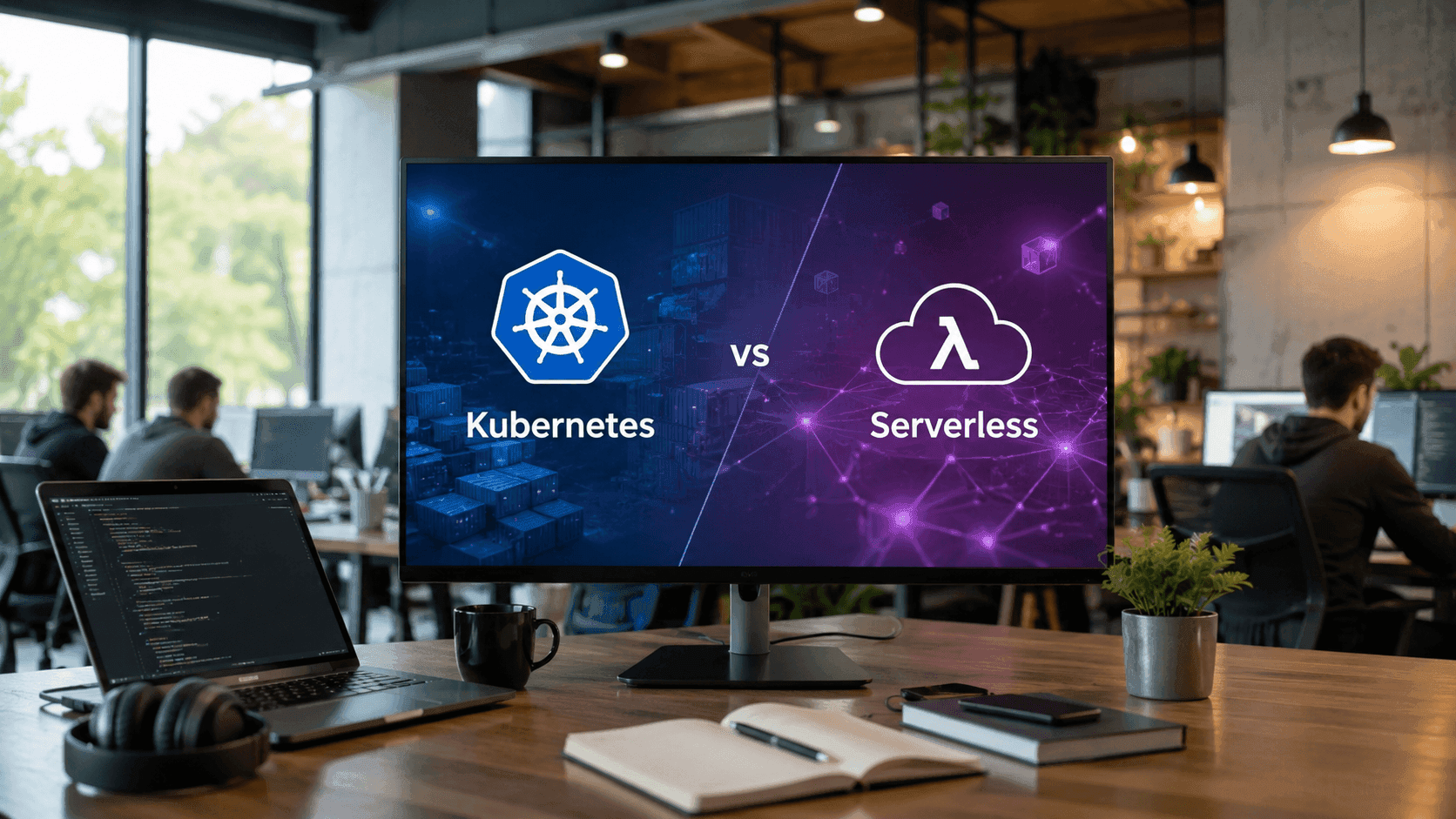
Kubernetes vs Serverless Startups: How to Scale Your Infrastructure
Establishing a reliable cloud infrastructure setup is one of the most critical decisions an early-stage founder faces. Choosing the wrong architectural path can deplete your cash runway, delay your launch, or result in massive refactoring bills down the line. In the debate of kubernetes vs serverless startups, making an informed decision requires balancing development velocity, operational complexity, and long-term hosting costs.
Kubernetes vs. Serverless: When to Choose Which?
When building a scalable cloud architecture for startups, founders are confronted with two fundamentally different paradigms: container orchestration (Kubernetes) and event-driven execution (Serverless).
The Case for Serverless in Early-Stage Startups
For early-stage companies, serverless frameworks (such as AWS Lambda) are often the gold standard for validating a product-market fit. Serverless architectures abstract away the underlying infrastructure entirely. There are no virtual servers to provision, patch, scale, or monitor.
This model offers significant advantages for small teams:
- Accelerated Speed-to-Market: Engineers focus exclusively on writing business logic rather than configuring networks or managing operating systems, significantly shortening the development cycle.
- Minimal Upfront Operational Cost: With a pay-as-you-go pricing structure, your infrastructure costs remain at or near zero dollars when there is no traffic. This is ideal for testing prototypes and launching a Minimum Viable Product (MVP) on a tight budget.
- Zero DevOps Overhead: Startups do not need to hire dedicated platform engineers immediately. Full-stack developers can write code and deploy it directly into production.
According to technical reviews on cloud adoption, serverless abstracts infrastructure and accelerates development for event-driven, smaller-scale, or highly erratic workload patterns, making it highly attractive for early-stage teams.
When Kubernetes Becomes Necessary
While serverless is exceptional for speed, Kubernetes (such as AWS EKS or Google GKE) becomes highly advantageous when a startup matures and begins handling predictable, high-volume workloads.
Kubernetes is justified when your system requires:
- Granular Infrastructure Control: Total authority over container runtimes, custom operating system packages, and complex local networking policies.
- Long-Running, State-Heavy Workloads: Applications that perform continuous data streaming, large-scale background processing, or run heavy, stateful databases that cannot tolerate arbitrary serverless execution limits (such as the standard 15-minute timeout on AWS Lambda).
- Predictable Scaling Economy: Once your user base stabilizes and traffic patterns become consistent, running steady-state virtual machines under Kubernetes becomes far more cost-effective than paying a premium for millions of individual serverless executions.
Industry research indicates that Kubernetes demands infrastructure control and expertise but remains exceptionally powerful for these complex, continuous, and stateful application profiles.
Kubernetes vs Serverless
Understanding the core mechanical differences between Kubernetes vs Lambda and general serverless technologies helps you align your tech stack with your business model.
Comparative Architectural Analysis
| Feature / Criteria | Serverless (e.g., AWS Lambda) | Kubernetes (e.g., Managed EKS/GKE) |
|---|---|---|
| Billing Model | Pay-as-you-go (per execution millisecond) | Fixed node/cluster costs (plus egress) |
| Operational Effort | Low (managed entirely by cloud vendor) | High (requires cluster management & DevOps) |
| Scaling Velocity | Instantaneous, highly elastic scaling | Metrics-based autoscaling (takes minutes) |
| Workload Profile | Short, event-driven microservices | Continuous, stateful, long-running services |
| Vendor Lock-in Risk | Moderate-High (cloud-specific APIs/triggers) | Extremely Low (open-source CNCF standard) |
The Reality of Kubernetes vs Serverless Startups Cost
From a financial perspective, the Serverless vs Kubernetes debate is a comparison of variable utility pricing against fixed capacity pricing.
In a serverless model, you only pay for what you consume. If your startup experiences highly spiky traffic—such as a B2B platform used heavily during business hours but idle at night—serverless scales down to zero, saving you thousands of dollars in wasted idle compute.
Conversely, Kubernetes requires a baseline operational cost to keep the control plane and minimal worker nodes active 24/7. However, at scale, the unit cost of compute in Kubernetes is dramatically lower. For continuous, high-volume workloads, serverless pay-per-request premiums accumulate rapidly. Detailed cloud analyses confirm that Kubernetes gives portability and fine-grained tuning but incurs fixed node costs, whereas serverless offers automated scaling but can become prohibitively expensive if continuous operations are run on execution-based pricing.
Cloud-Kubernetes and Serverless: How They Fit into...
Choosing an infrastructure strategy shapes not only your software but also your organizational culture and hiring needs.
Operational Overhead and Team Dynamics
Managing cloud-native systems requires distinct engineering skill sets. A serverless architecture allows a startup to run lean. By letting the cloud provider manage server provisioning, load balancing, and operating system security updates, your team can focus exclusively on shipping features.
On the other hand, running a Kubernetes cluster introduces considerable platform complexity. Your engineering team must design, monitor, and maintain:
- Ingress controllers and API gateways for routing traffic.
- Network security policies and access controls.
- Persistent storage volumes for databases.
- Continuous backup systems and disaster recovery protocols.
For a small startup, dedicating precious engineering hours to platform maintenance can slow down product development. This division of labor is a critical factor when choosing kubernetes vs serverless use cases. If your team lacks specialized platform engineers, attempting to manage a raw Kubernetes cluster can lead to misconfigurations, security vulnerabilities, and unexpected cloud bills.
Serverless vs. Kubernetes: Is there a right path?
Fortunately, startups do not have to choose a single technology forever. Many successful companies leverage a progressive, multi-stage hybrid approach to bridge these two technologies.
The Hybrid Scaling Blueprint
A highly effective paradigm for modern SaaS startups is to start serverless to validate the MVP, and then migrate core, steady-state workloads to Kubernetes once they reach scaling and cost thresholds.
Stage 1: MVP Validation (Serverless)
[User Requests] ---> [API Gateway] ---> [Serverless Functions (Zero Idle Costs)]

Stage 2: Scale & Optimization (Hybrid)
[User Requests] ---> [API Gateway]
                           |
                           +---> (Steady High-Volume Traffic) ---> [Kubernetes Cluster]
                           |
                           +---> (Spiky Event-Driven Tasks)  ---> [Serverless Functions]
This hybrid model allows you to maximize speed and minimize costs during the early stages of your venture. By isolating your components, you can keep highly volatile, event-driven tasks (like email notifications, file uploads, or webhooks) on serverless, while migrating core transactional APIs and data processing layers to a managed Kubernetes cluster.
Technical evaluations of microservice architectures support this path, showing that a popular pattern for SaaS startups is a hybrid strategy: validate quickly with serverless, then gradually shift steady-state components to managed containers to optimize efficiency and unit economics.
To execute this migration smoothly in the future, developers should write clean, modular code and package application logic inside standard container wrappers (like Docker) from day one. This keeps your software fully portable, allowing you to transition between serverless container runtimes (such as AWS Fargate) and dedicated Kubernetes clusters without rewriting your application.
Kubernetes vs Serverless in 2026: The Honest Decision...
As the cloud ecosystem becomes more sophisticated, startup founders must cut through the industry hype to make pragmatic infrastructure decisions.
Making the Decision for Your Startup
When deciding which path to take, ask your leadership team these critical questions:
- How predictable is our traffic? If you are launching a brand-new application with unknown, highly volatile usage, start with serverless. If you have predictable, constant traffic or run background processes that execute continuously, Kubernetes will save you money.
- What is our current engineering capability? Do you have dedicated DevOps resources, or are you a small team of full-stack developers? If you lack specialized system administrators, serverless allows you to operate safely without infrastructure overhead.
- What are our security and compliance needs? If you operate in highly regulated spaces (such as fintech or healthcare) that require custom firewall configurations, dedicated IP addresses, and deep network isolation, Kubernetes offers the robust control needed to pass strict compliance audits.
Scale Confidently with Mpowered Ventures
For non-technical founders, navigating these complex architectural decisions while building a brand can be overwhelming. You do not have to make these high-stakes technology trade-offs alone.
At Mpowered Ventures, we act as your complete, dedicated tech department. Through our unique technical co-founder model, we invest our technical execution directly into your startup in exchange for equity—aligning our success entirely with your growth.
We handle end-to-end cloud infrastructure engineering, deploying secure, scalable, and highly reliable architectures on AWS, GCP, or Azure with Terraform and Kubernetes. We couple this technical execution with data-driven growth marketing for small businesses (including SEO, GEO, and high-converting paid ads) to acquire your first customers. Whether you are building an early-stage serverless MVP or migrating to a high-performance Kubernetes cluster, we deliver enterprise-quality execution at startup-friendly prices.
Reach out to Mpowered Ventures today to establish an infrastructure foundation designed to scale seamlessly from MVP to enterprise.
Sources
- Cloud-Kubernetes and Serverless: How They Fit into Modern DevOps — https://compunnel.com/blogs/cloud-kubernetes-and-serverless-how-they-fit-into-modern-devops
- Kubernetes vs. Serverless: When to Choose Which? | Simple Talk — https://red-gate.com/simple-talk/devops/containers-and-virtualization/kubernetes-vs-serverless-when-to-choose-which
Stay updated on tech trends
Join our mailing list for exclusive insights and practical tech advice delivered to your inbox.
Other Blog Posts















For Businesses
Need expertise on your next technical challenge? our team is here to help.
M Powered Ventures Editorial Team
Founder of startup x


M Powered Ventures Editorial Team
Founder of startup x
M Powered Ventures editorial team

Startup Accelerator vs. Seed Funding for Tech Startups: Which Path Is Right for You?
Posted by M Powered Ventures Editorial Team |.July 25 2026

Startup Accelerator or Mentor Network? How Founders Should Choose the Right Growth Support
Posted by M Powered Ventures Editorial Team |.July 25 2026

Technical Roadmap Template for Founders Before Building a Product
Posted by M Powered Ventures Editorial Team |.July 25 2026
You May Also Like
M Powered Ventures supports startups and companies by providing world-class tech expertise.
Have questions about implementing these ideas?
We're here to help.Contact Usfor a free consultation orPitch Your Startupif you're looking for a technical co-founder.
